• Domain-Specific AI Models vs. General-Purpose LLMs
    Artificial intelligence is becoming an essential component of enterprise operations, helping businesses automate workflows, analyze information, and improve decision-making. As organizations explore AI adoption, one important consideration is choosing between domain-specific AI models and general-purpose large language models (LLMs). Both approaches offer significant capabilities, but their effectiveness depends on business requirements, data availability, and operational complexity.

    Understanding the differences between these models enables enterprises to select AI solutions that deliver meaningful business value while balancing performance, cost, and scalability.

    Understanding General-Purpose LLMs
    General-purpose LLMs are artificial intelligence systems trained on large and diverse datasets to understand and generate human language. They can perform various tasks, including content creation, summarization, translation, coding, research assistance, and conversational interactions.

    Their versatility makes them useful across multiple industries and business functions. Organizations can deploy general-purpose models for customer support, employee productivity, marketing content, and knowledge management.

    One significant advantage is their ability to handle different tasks without requiring extensive customization. Businesses can often integrate these models through application programming interfaces (APIs), reducing the time needed to introduce AI capabilities.

    However, general-purpose models may lack the specialized knowledge required for complex industry-specific applications. They can also produce inaccurate information, struggle with proprietary terminology, or require additional context to generate reliable responses.

    What Are Domain-Specific AI Models?
    Domain-specific AI models are designed or adapted to perform tasks within a particular industry, business function, or specialized knowledge area. They may be trained on industry-focused datasets, fine-tuned using specialized information, or connected to trusted domain-specific knowledge sources.

    Examples include AI models designed for healthcare documentation, financial risk analysis, legal research, cybersecurity threat detection, and manufacturing operations.

    These models are developed to understand specialized terminology, industry workflows, and relevant regulatory requirements. Their focused capabilities can improve accuracy and relevance for particular business applications.

    For example, a financial services organization may use a domain-specific AI model to analyze financial reports, identify potential risks, and support compliance workflows. A general-purpose LLM may assist with summarizing the same documents, but a specialized model could provide more consistent results when configured and validated for the required task.

    Key Differences Between Domain-Specific AI and General-Purpose LLMs
    1. Accuracy and Specialized Knowledge
    General-purpose LLMs offer broad knowledge across multiple subjects, making them suitable for diverse tasks. Domain-specific models focus on specialized information, which can improve performance in particular applications.

    However, specialization does not automatically guarantee accuracy. Both approaches require reliable data, evaluation, and human oversight, especially in high-impact business environments.

    2. Development and Deployment Costs
    General-purpose LLMs can reduce initial development costs because businesses can access existing models through APIs or managed platforms.

    Domain-specific AI may require investment in data preparation, model fine-tuning, infrastructure, and specialized expertise. Nevertheless, a focused model can potentially reduce operational expenses when it performs a repetitive task more efficiently or requires fewer computing resources.

    Organizations should evaluate total cost of ownership rather than comparing model prices alone.

    3. Flexibility and Scalability
    General-purpose LLMs are highly flexible and can support multiple business applications. This makes them attractive for organizations exploring different AI use cases.

    Domain-specific models may be less versatile but can provide better alignment with established workflows. Their scalability depends on infrastructure, data quality, integration requirements, and the complexity of the target application.

    Choosing the Right AI Approach for Enterprises
    Businesses should begin by identifying their objectives, data requirements, risk tolerance, and expected outcomes.

    General-purpose LLMs are often suitable for content generation, internal knowledge assistance, brainstorming, and broad productivity improvements.

    Domain-specific AI models may be preferable for specialized workflows involving technical documentation, financial analysis, healthcare information, or industry-specific decision support.

    A hybrid approach can also deliver strong results. Enterprises may combine a general-purpose LLM with retrieval-augmented generation (RAG), specialized data sources, and domain-specific models to balance flexibility with contextual accuracy.

    Conclusion
    Domain-specific AI models and general-purpose LLMs serve different enterprise needs. General-purpose models provide versatility and faster implementation, while domain-specific models offer focused capabilities for specialized applications.

    The most effective strategy depends on business objectives, data quality, deployment costs, and required accuracy. By evaluating these factors carefully, organizations can build AI strategies that improve operational efficiency, strengthen decision-making, and deliver sustainable competitive advantages.

    Read More: https://theinfotech.info/
    Domain-Specific AI Models vs. General-Purpose LLMs Artificial intelligence is becoming an essential component of enterprise operations, helping businesses automate workflows, analyze information, and improve decision-making. As organizations explore AI adoption, one important consideration is choosing between domain-specific AI models and general-purpose large language models (LLMs). Both approaches offer significant capabilities, but their effectiveness depends on business requirements, data availability, and operational complexity. Understanding the differences between these models enables enterprises to select AI solutions that deliver meaningful business value while balancing performance, cost, and scalability. Understanding General-Purpose LLMs General-purpose LLMs are artificial intelligence systems trained on large and diverse datasets to understand and generate human language. They can perform various tasks, including content creation, summarization, translation, coding, research assistance, and conversational interactions. Their versatility makes them useful across multiple industries and business functions. Organizations can deploy general-purpose models for customer support, employee productivity, marketing content, and knowledge management. One significant advantage is their ability to handle different tasks without requiring extensive customization. Businesses can often integrate these models through application programming interfaces (APIs), reducing the time needed to introduce AI capabilities. However, general-purpose models may lack the specialized knowledge required for complex industry-specific applications. They can also produce inaccurate information, struggle with proprietary terminology, or require additional context to generate reliable responses. What Are Domain-Specific AI Models? Domain-specific AI models are designed or adapted to perform tasks within a particular industry, business function, or specialized knowledge area. They may be trained on industry-focused datasets, fine-tuned using specialized information, or connected to trusted domain-specific knowledge sources. Examples include AI models designed for healthcare documentation, financial risk analysis, legal research, cybersecurity threat detection, and manufacturing operations. These models are developed to understand specialized terminology, industry workflows, and relevant regulatory requirements. Their focused capabilities can improve accuracy and relevance for particular business applications. For example, a financial services organization may use a domain-specific AI model to analyze financial reports, identify potential risks, and support compliance workflows. A general-purpose LLM may assist with summarizing the same documents, but a specialized model could provide more consistent results when configured and validated for the required task. Key Differences Between Domain-Specific AI and General-Purpose LLMs 1. Accuracy and Specialized Knowledge General-purpose LLMs offer broad knowledge across multiple subjects, making them suitable for diverse tasks. Domain-specific models focus on specialized information, which can improve performance in particular applications. However, specialization does not automatically guarantee accuracy. Both approaches require reliable data, evaluation, and human oversight, especially in high-impact business environments. 2. Development and Deployment Costs General-purpose LLMs can reduce initial development costs because businesses can access existing models through APIs or managed platforms. Domain-specific AI may require investment in data preparation, model fine-tuning, infrastructure, and specialized expertise. Nevertheless, a focused model can potentially reduce operational expenses when it performs a repetitive task more efficiently or requires fewer computing resources. Organizations should evaluate total cost of ownership rather than comparing model prices alone. 3. Flexibility and Scalability General-purpose LLMs are highly flexible and can support multiple business applications. This makes them attractive for organizations exploring different AI use cases. Domain-specific models may be less versatile but can provide better alignment with established workflows. Their scalability depends on infrastructure, data quality, integration requirements, and the complexity of the target application. Choosing the Right AI Approach for Enterprises Businesses should begin by identifying their objectives, data requirements, risk tolerance, and expected outcomes. General-purpose LLMs are often suitable for content generation, internal knowledge assistance, brainstorming, and broad productivity improvements. Domain-specific AI models may be preferable for specialized workflows involving technical documentation, financial analysis, healthcare information, or industry-specific decision support. A hybrid approach can also deliver strong results. Enterprises may combine a general-purpose LLM with retrieval-augmented generation (RAG), specialized data sources, and domain-specific models to balance flexibility with contextual accuracy. Conclusion Domain-specific AI models and general-purpose LLMs serve different enterprise needs. General-purpose models provide versatility and faster implementation, while domain-specific models offer focused capabilities for specialized applications. The most effective strategy depends on business objectives, data quality, deployment costs, and required accuracy. By evaluating these factors carefully, organizations can build AI strategies that improve operational efficiency, strengthen decision-making, and deliver sustainable competitive advantages. Read More: https://theinfotech.info/
    0 Comments 0 Shares
  • AI training institute in Punjab

    When looking for the Best AI Courses in Punjab, learners can consider institutes offering practical training across Machine Learning, Deep Learning, Generative AI, LLMs, RAG, and AI agents. Grow2Grab is an AI training institute in Punjab with live mentor-led courses, hands-on projects, structured learning, and placement assistance. Its programs range from AI fundamentals and Python to Generative AI, autonomous agents, deployment, and full-stack AI applications.

    Visit now: https://www.grow2grab.com/ai-training-institute-in-punjab
    AI training institute in Punjab When looking for the Best AI Courses in Punjab, learners can consider institutes offering practical training across Machine Learning, Deep Learning, Generative AI, LLMs, RAG, and AI agents. Grow2Grab is an AI training institute in Punjab with live mentor-led courses, hands-on projects, structured learning, and placement assistance. Its programs range from AI fundamentals and Python to Generative AI, autonomous agents, deployment, and full-stack AI applications. Visit now: https://www.grow2grab.com/ai-training-institute-in-punjab
    Best AI Training Institute in Jalandhar | Grow2Grab
    Punjab's leading AI training institute — 8 programmes, live mentor-led, real projects, placement support. Jalandhar + online across Punjab.
    0 Comments 0 Shares
  • Generative AI Is Changing How Developers Build Intelligent Products

    Traditional applications primarily rely on predefined logic and structured workflows.

    Generative AI introduces a new approach to applications that can understand natural language, generate content, retrieve information, summarize data, and interact intelligently with users.

    This shift is creating new possibilities across software development, customer support, education, marketing, healthcare, finance, automation, and enterprise applications.

    ๐ŸŽฏ Master the Generative AI Development Stack

    โœ… Generative AI Fundamentals
    โœ… Large Language Models
    โœ… Prompt Engineering
    โœ… AI APIs & Model Integration
    โœ… Embeddings & Vector Databases

    Our Generative AI Course focuses on helping learners understand the complete development process from Generative AI fundamentals and LLMs to building functional AI-powered applications.

    ๐Ÿ“š Learn the core concepts.
    ๐Ÿง‘‍๐Ÿ’ป Practice with modern AI development tools.
    ๐Ÿค– Build intelligent applications.
    ๐Ÿš€ Gain hands-on experience through practical projects.

    Whether you're starting your AI journey or looking to strengthen your existing development skills, this course helps you build a practical foundation for the rapidly evolving Generative AI ecosystem.

    Zenshin Technologies Pvt Ltd

    ๐ŸŒ Visit:https://www.zenshintechnologies.com/courses/generative-ai-course

    ๐Ÿ“ง Mail: contact@zenshintechnologies.com
    ๐Ÿ“ฑ WhatsApp: 8056565980

    #GenerativeAI #AIDevelopment #ArtificialIntelligence #LLM #LargeLanguageModels #PromptEngineering #RAG #AIApplications #AIDeveloper #AIEngineer #MachineLearning #GenerativeAITechnology #FutureOfAI #TechSkills #ZenshinTechnologies
    Generative AI Is Changing How Developers Build Intelligent Products Traditional applications primarily rely on predefined logic and structured workflows. Generative AI introduces a new approach to applications that can understand natural language, generate content, retrieve information, summarize data, and interact intelligently with users. This shift is creating new possibilities across software development, customer support, education, marketing, healthcare, finance, automation, and enterprise applications. ๐ŸŽฏ Master the Generative AI Development Stack โœ… Generative AI Fundamentals โœ… Large Language Models โœ… Prompt Engineering โœ… AI APIs & Model Integration โœ… Embeddings & Vector Databases Our Generative AI Course focuses on helping learners understand the complete development process from Generative AI fundamentals and LLMs to building functional AI-powered applications. ๐Ÿ“š Learn the core concepts. ๐Ÿง‘‍๐Ÿ’ป Practice with modern AI development tools. ๐Ÿค– Build intelligent applications. ๐Ÿš€ Gain hands-on experience through practical projects. Whether you're starting your AI journey or looking to strengthen your existing development skills, this course helps you build a practical foundation for the rapidly evolving Generative AI ecosystem. Zenshin Technologies Pvt Ltd ๐ŸŒ Visit:https://www.zenshintechnologies.com/courses/generative-ai-course ๐Ÿ“ง Mail: contact@zenshintechnologies.com ๐Ÿ“ฑ WhatsApp: 8056565980 #GenerativeAI #AIDevelopment #ArtificialIntelligence #LLM #LargeLanguageModels #PromptEngineering #RAG #AIApplications #AIDeveloper #AIEngineer #MachineLearning #GenerativeAITechnology #FutureOfAI #TechSkills #ZenshinTechnologies
    0 Comments 0 Shares
  • Conversational AI for Intelligent Contact Center Market: Agentic AI Redefines Customer Experience

    QKS Group’s Conversational AI for Intelligent Contact Center (ICC) market research provides a comprehensive analysis of the global market, covering emerging technology trends, evolving market dynamics, competitive developments, and the future market outlook. The research offers strategic insights to technology vendors to strengthen their growth strategies while helping enterprises evaluate vendors based on capabilities, competitive differentiation, and market positioning.

    Click here for more information : https://qksgroup.com/market-research/spark-matrix-conversational-ai-for-intelligent-contact-center-icc-q4-2025-10298

    Conversational AI for Intelligent Contact Centers Enters a New Era
    Conversational AI is becoming a strategic technology for organizations seeking to modernize intelligent contact centers and deliver faster, more personalized customer interactions. Traditional contact center environments that relied heavily on rule-based systems, scripted workflows, and predefined intent recognition are increasingly evolving toward AI-driven platforms capable of understanding context, reasoning across complex interactions, and taking action.

    Agentic AI Becomes a Key Market Driver
    According to Analyst at QKS Group, “Conversational AI for Intelligent Contact Center (ICC) is entering a transformative phase marked by the emergence of agentic AI which is capable of autonomous reasoning, planning, and execution with minimal human intervention.”

    From Intent-Based Models to Context-Aware AI Agents
    Earlier generations of conversational AI primarily depended on predefined intents, decision trees, and structured dialogue flows. While these technologies remain useful for predictable interactions, they can struggle when customers use ambiguous language, change topics, or present complex requirements.

    Modern conversational AI platforms are increasingly incorporating LLM-powered architectures that enable more flexible and context-aware interactions. Context retention and persistent memory allow AI systems to maintain continuity across conversations, while enterprise knowledge integration enables agents to retrieve relevant information and generate more meaningful responses.

    Convergence of Conversational Intelligence and Automation
    Another major trend shaping the Conversational AI for Intelligent Contact Center market is the convergence of conversational intelligence, workflow automation, and analytics.

    Download Sample Report : https://qksgroup.com/download-sample-form/spark-matrix-conversational-ai-for-intelligent-contact-center-icc-q4-2025-10298

    Contact centers are increasingly looking beyond automated responses and focusing on complete interaction journeys. AI-powered platforms can analyze conversations, identify customer intent and sentiment, recommend next-best actions, automate workflows, and provide insights into agent and customer performance.

    Human-AI Collaboration Reshapes Contact Center Operations
    The rise of autonomous AI does not necessarily eliminate the role of human agents. Instead, it is creating opportunities for human-AI collaboration in contact centers.

    AI agents can manage routine interactions and repetitive workflows, allowing human employees to focus on complex, sensitive, or high-value customer interactions. AI copilots can also provide real-time recommendations, retrieve relevant knowledge, summarize conversations, and support agents
    during customer engagements.

    Governance Becomes a Strategic Priority
    As conversational AI agents gain greater autonomy, governance becomes increasingly important. Organizations must establish frameworks for transparency, accountability, security, privacy, and operational control.

    Analyst further emphasizes that “The strategic imperative for users now lies in instituting rigorous governance frameworks that ensure transparency, accountability, and control as these autonomous agents assume a growing role in operational and decision making processes.”

    SPARK Matrix Evaluates Leading Conversational AI Vendors
    QKS Group’s research includes detailed competitive analysis and vendor evaluation using its proprietary SPARK Matrix™ methodology. The framework assesses vendors based on their technology capabilities, competitive differentiation, and market positioning.

    The evaluated vendors include 8x8, Avaamo, Avaya, Balto, Cisco, Content Guru, Creative Virtual, Dialpad, Five9, Genesys, Kore.ai, NiCE Cognigy, SoundHound AI, Talkdesk, Vonage, and Replicant.

    Future Outlook for Conversational AI in Intelligent Contact Centers
    The future of intelligent contact centers will increasingly be defined by AI agents that can reason, learn from context, coordinate workflows, and collaborate with human employees. As LLMs, enterprise knowledge, orchestration technologies, and analytics become more deeply integrated, conversational AI platforms are expected to evolve into broader intelligent automation environments.

    QKS Group’s Conversational AI for Intelligent Contact Center market research provides valuable market intelligence for vendors and technology buyers seeking to understand these developments, assess competitive positioning, and prepare for the next phase of intelligent contact center transformation.
    Conversational AI for Intelligent Contact Center Market: Agentic AI Redefines Customer Experience QKS Group’s Conversational AI for Intelligent Contact Center (ICC) market research provides a comprehensive analysis of the global market, covering emerging technology trends, evolving market dynamics, competitive developments, and the future market outlook. The research offers strategic insights to technology vendors to strengthen their growth strategies while helping enterprises evaluate vendors based on capabilities, competitive differentiation, and market positioning. Click here for more information : https://qksgroup.com/market-research/spark-matrix-conversational-ai-for-intelligent-contact-center-icc-q4-2025-10298 Conversational AI for Intelligent Contact Centers Enters a New Era Conversational AI is becoming a strategic technology for organizations seeking to modernize intelligent contact centers and deliver faster, more personalized customer interactions. Traditional contact center environments that relied heavily on rule-based systems, scripted workflows, and predefined intent recognition are increasingly evolving toward AI-driven platforms capable of understanding context, reasoning across complex interactions, and taking action. Agentic AI Becomes a Key Market Driver According to Analyst at QKS Group, “Conversational AI for Intelligent Contact Center (ICC) is entering a transformative phase marked by the emergence of agentic AI which is capable of autonomous reasoning, planning, and execution with minimal human intervention.” From Intent-Based Models to Context-Aware AI Agents Earlier generations of conversational AI primarily depended on predefined intents, decision trees, and structured dialogue flows. While these technologies remain useful for predictable interactions, they can struggle when customers use ambiguous language, change topics, or present complex requirements. Modern conversational AI platforms are increasingly incorporating LLM-powered architectures that enable more flexible and context-aware interactions. Context retention and persistent memory allow AI systems to maintain continuity across conversations, while enterprise knowledge integration enables agents to retrieve relevant information and generate more meaningful responses. Convergence of Conversational Intelligence and Automation Another major trend shaping the Conversational AI for Intelligent Contact Center market is the convergence of conversational intelligence, workflow automation, and analytics. Download Sample Report : https://qksgroup.com/download-sample-form/spark-matrix-conversational-ai-for-intelligent-contact-center-icc-q4-2025-10298 Contact centers are increasingly looking beyond automated responses and focusing on complete interaction journeys. AI-powered platforms can analyze conversations, identify customer intent and sentiment, recommend next-best actions, automate workflows, and provide insights into agent and customer performance. Human-AI Collaboration Reshapes Contact Center Operations The rise of autonomous AI does not necessarily eliminate the role of human agents. Instead, it is creating opportunities for human-AI collaboration in contact centers. AI agents can manage routine interactions and repetitive workflows, allowing human employees to focus on complex, sensitive, or high-value customer interactions. AI copilots can also provide real-time recommendations, retrieve relevant knowledge, summarize conversations, and support agents during customer engagements. Governance Becomes a Strategic Priority As conversational AI agents gain greater autonomy, governance becomes increasingly important. Organizations must establish frameworks for transparency, accountability, security, privacy, and operational control. Analyst further emphasizes that “The strategic imperative for users now lies in instituting rigorous governance frameworks that ensure transparency, accountability, and control as these autonomous agents assume a growing role in operational and decision making processes.” SPARK Matrix Evaluates Leading Conversational AI Vendors QKS Group’s research includes detailed competitive analysis and vendor evaluation using its proprietary SPARK Matrix™ methodology. The framework assesses vendors based on their technology capabilities, competitive differentiation, and market positioning. The evaluated vendors include 8x8, Avaamo, Avaya, Balto, Cisco, Content Guru, Creative Virtual, Dialpad, Five9, Genesys, Kore.ai, NiCE Cognigy, SoundHound AI, Talkdesk, Vonage, and Replicant. Future Outlook for Conversational AI in Intelligent Contact Centers The future of intelligent contact centers will increasingly be defined by AI agents that can reason, learn from context, coordinate workflows, and collaborate with human employees. As LLMs, enterprise knowledge, orchestration technologies, and analytics become more deeply integrated, conversational AI platforms are expected to evolve into broader intelligent automation environments. QKS Group’s Conversational AI for Intelligent Contact Center market research provides valuable market intelligence for vendors and technology buyers seeking to understand these developments, assess competitive positioning, and prepare for the next phase of intelligent contact center transformation.
    QKSGROUP.COM
    SPARK Matrix™: Conversational AI for Intelligent Contact Center (ICC), Q4 2025
    Compare top Conversational AI for ICC vendors with QKS Group's SPARK Matrix™, featuring rankings, trends, and competitive analysis for 2025.
    1
    0 Comments 0 Shares
  • AI Security Intelligence Brief: The Week’s Most Important Threats

    Artificial intelligence is rapidly becoming part of enterprise technology stacks, security operations, software development, customer services, and business decision-making. While AI creates significant opportunities, its rapid adoption is also introducing new cybersecurity risks.

    The AI Security Intelligence Brief provides a focused view of the most important AI security threats, vulnerabilities, attack techniques, and emerging risks that organizations should monitor.

    AI Attack Surfaces Are Expanding
    AI systems are no longer isolated experiments. Organizations are integrating large language models (LLMs), AI assistants, machine learning platforms, autonomous agents, and third-party AI services into business workflows.

    This creates new attack surfaces involving models, prompts, APIs, identities, data, plugins, integrations, and infrastructure.

    Security teams must therefore consider not only whether an AI model is secure, but also how the surrounding ecosystem can be exploited.

    Prompt Injection Remains a Key Concern
    Prompt injection continues to represent an important AI security challenge. Attackers can craft malicious instructions designed to manipulate an AI system into ignoring intended controls or performing unintended actions.

    The risk becomes greater when AI systems have access to enterprise data or external tools.

    An AI agent with permission to retrieve documents, interact with applications, or execute workflows could potentially turn a successful prompt manipulation into a broader security incident.

    Organizations should treat AI instructions and external content as potentially untrusted inputs.

    AI-Powered Social Engineering Is Increasingly Sophisticated
    Generative AI can make phishing and social engineering campaigns more convincing.

    Attackers can generate highly personalized messages, create realistic business communications, and adapt content to specific targets. This can make traditional indicators of phishing more difficult for employees to recognize.

    Security awareness programs therefore need to evolve alongside AI-enabled attack techniques.

    Organizations should combine employee education with strong authentication, email security, identity protection, and behavioral monitoring.

    AI Systems Can Create New Data Security Risks
    AI applications frequently require access to corporate information to provide useful responses. This introduces questions about what data an AI system can access, where that information is processed, and who can retrieve it.

    Potential risks include:

    Sensitive data exposure
    Excessive AI application permissions
    Unauthorized data retrieval
    Insecure third-party AI integrations
    Poorly governed enterprise AI tools
    Accidental disclosure through prompts
    Organizations should establish clear policies for what information employees and AI applications are permitted to access.

    AI Agents Introduce Additional Security Challenges
    The evolution from conversational AI to autonomous AI agents is creating another important security consideration.

    AI agents may be capable of taking actions rather than simply generating responses. Depending on their design, they may interact with databases, applications, APIs, or business workflows.

    This increases the importance of:

    Least-privilege permissions
    Strong authentication
    Tool access controls
    Action logging
    Human approval for high-risk actions
    Continuous monitoring
    An AI agent should have only the access required for its specific function.

    The Importance of AI Security Monitoring
    AI security cannot depend entirely on predeployment testing. Models, applications, integrations, permissions, and threats can change over time.

    Security teams should continuously monitor AI environments for unusual behavior, unexpected data access, unauthorized integrations, and changes in permissions.

    AI security should also be incorporated into existing security operations rather than treated as a completely separate discipline.

    What Security Leaders Should Watch
    Organizations should closely monitor several areas of AI security:

    Model Security: Vulnerabilities and weaknesses affecting AI models and applications.

    Identity: Accounts, credentials, and permissions associated with AI systems.

    Data: Sensitive information accessed, processed, or generated by AI applications.

    Integrations: APIs, plugins, tools, and external services connected to AI systems.

    Agents: Autonomous systems capable of taking actions on behalf of users.

    Threat Activity: Emerging attack techniques targeting AI-enabled environments.

    Building a Stronger AI Security Strategy
    Organizations can reduce AI-related risks by establishing governance before expanding AI adoption.

    Security leaders should:

    Maintain an inventory of approved AI applications.
    Define acceptable AI data usage policies.
    Apply least privilege to AI services and agents.
    Monitor AI-related identities and integrations.
    Test applications for prompt injection and other AI-specific threats.
    Protect sensitive information from unauthorized AI access.
    Establish incident response procedures for AI-related security events.
    Continuously reassess AI risks as technologies evolve.
    Conclusion
    AI security is becoming a core enterprise cybersecurity priority as organizations rapidly integrate AI into business operations.

    The most important risks are not limited to vulnerabilities within AI models themselves. Attackers can target identities, data, integrations, prompts, APIs, and autonomous agents surrounding those models.

    A strong AI Security Intelligence program helps organizations stay ahead of these evolving risks by continuously tracking emerging threats, understanding new attack techniques, and translating developments into actionable security priorities.

    For security leaders, the objective is clear: adopt AI responsibly while ensuring that increased automation does not create unmanaged pathways into critical business systems and data.

    About Cyber Tech Intelligence
    Cyber Tech Intelligence is a leading cybersecurity intelligence platform dedicated to delivering research-driven insights, threat intelligence, and strategic analysis across the evolving cybersecurity landscape. We help enterprises, CISOs, technology leaders, and cybersecurity vendors navigate emerging threats, security technologies, and business risks with confidence. Our expertise spans AI Security, Threat Intelligence, Cloud Security, Identity Security, Zero Trust, SIEM, XDR, DevSecOps, Application Security, and Enterprise Cyber Resilience. Through independent research, executive engagement, and market intelligence, we provide actionable insights that support informed decision-making and stronger security outcomes.

    At Cyber Tech Intelligence, we believe effective cybersecurity strategies are built on trusted intelligence, transparency, and strategic relevance. Our services include cybersecurity research reports, threat trend analysis, executive briefings, vendor intelligence, CISO engagement programs, webinars, and advisory services designed to help organizations stay resilient in a rapidly changing threat environment. Whether you are looking for strategic cybersecurity insights, partnership opportunities, or expert guidance, our team is ready to help. Contact Us to connect with our cybersecurity experts and learn how we can support your organization’s security goals.


    AI Security Intelligence Brief: The Week’s Most Important Threats Artificial intelligence is rapidly becoming part of enterprise technology stacks, security operations, software development, customer services, and business decision-making. While AI creates significant opportunities, its rapid adoption is also introducing new cybersecurity risks. The AI Security Intelligence Brief provides a focused view of the most important AI security threats, vulnerabilities, attack techniques, and emerging risks that organizations should monitor. AI Attack Surfaces Are Expanding AI systems are no longer isolated experiments. Organizations are integrating large language models (LLMs), AI assistants, machine learning platforms, autonomous agents, and third-party AI services into business workflows. This creates new attack surfaces involving models, prompts, APIs, identities, data, plugins, integrations, and infrastructure. Security teams must therefore consider not only whether an AI model is secure, but also how the surrounding ecosystem can be exploited. Prompt Injection Remains a Key Concern Prompt injection continues to represent an important AI security challenge. Attackers can craft malicious instructions designed to manipulate an AI system into ignoring intended controls or performing unintended actions. The risk becomes greater when AI systems have access to enterprise data or external tools. An AI agent with permission to retrieve documents, interact with applications, or execute workflows could potentially turn a successful prompt manipulation into a broader security incident. Organizations should treat AI instructions and external content as potentially untrusted inputs. AI-Powered Social Engineering Is Increasingly Sophisticated Generative AI can make phishing and social engineering campaigns more convincing. Attackers can generate highly personalized messages, create realistic business communications, and adapt content to specific targets. This can make traditional indicators of phishing more difficult for employees to recognize. Security awareness programs therefore need to evolve alongside AI-enabled attack techniques. Organizations should combine employee education with strong authentication, email security, identity protection, and behavioral monitoring. AI Systems Can Create New Data Security Risks AI applications frequently require access to corporate information to provide useful responses. This introduces questions about what data an AI system can access, where that information is processed, and who can retrieve it. Potential risks include: Sensitive data exposure Excessive AI application permissions Unauthorized data retrieval Insecure third-party AI integrations Poorly governed enterprise AI tools Accidental disclosure through prompts Organizations should establish clear policies for what information employees and AI applications are permitted to access. AI Agents Introduce Additional Security Challenges The evolution from conversational AI to autonomous AI agents is creating another important security consideration. AI agents may be capable of taking actions rather than simply generating responses. Depending on their design, they may interact with databases, applications, APIs, or business workflows. This increases the importance of: Least-privilege permissions Strong authentication Tool access controls Action logging Human approval for high-risk actions Continuous monitoring An AI agent should have only the access required for its specific function. The Importance of AI Security Monitoring AI security cannot depend entirely on predeployment testing. Models, applications, integrations, permissions, and threats can change over time. Security teams should continuously monitor AI environments for unusual behavior, unexpected data access, unauthorized integrations, and changes in permissions. AI security should also be incorporated into existing security operations rather than treated as a completely separate discipline. What Security Leaders Should Watch Organizations should closely monitor several areas of AI security: Model Security: Vulnerabilities and weaknesses affecting AI models and applications. Identity: Accounts, credentials, and permissions associated with AI systems. Data: Sensitive information accessed, processed, or generated by AI applications. Integrations: APIs, plugins, tools, and external services connected to AI systems. Agents: Autonomous systems capable of taking actions on behalf of users. Threat Activity: Emerging attack techniques targeting AI-enabled environments. Building a Stronger AI Security Strategy Organizations can reduce AI-related risks by establishing governance before expanding AI adoption. Security leaders should: Maintain an inventory of approved AI applications. Define acceptable AI data usage policies. Apply least privilege to AI services and agents. Monitor AI-related identities and integrations. Test applications for prompt injection and other AI-specific threats. Protect sensitive information from unauthorized AI access. Establish incident response procedures for AI-related security events. Continuously reassess AI risks as technologies evolve. Conclusion AI security is becoming a core enterprise cybersecurity priority as organizations rapidly integrate AI into business operations. The most important risks are not limited to vulnerabilities within AI models themselves. Attackers can target identities, data, integrations, prompts, APIs, and autonomous agents surrounding those models. A strong AI Security Intelligence program helps organizations stay ahead of these evolving risks by continuously tracking emerging threats, understanding new attack techniques, and translating developments into actionable security priorities. For security leaders, the objective is clear: adopt AI responsibly while ensuring that increased automation does not create unmanaged pathways into critical business systems and data. About Cyber Tech Intelligence Cyber Tech Intelligence is a leading cybersecurity intelligence platform dedicated to delivering research-driven insights, threat intelligence, and strategic analysis across the evolving cybersecurity landscape. We help enterprises, CISOs, technology leaders, and cybersecurity vendors navigate emerging threats, security technologies, and business risks with confidence. Our expertise spans AI Security, Threat Intelligence, Cloud Security, Identity Security, Zero Trust, SIEM, XDR, DevSecOps, Application Security, and Enterprise Cyber Resilience. Through independent research, executive engagement, and market intelligence, we provide actionable insights that support informed decision-making and stronger security outcomes. At Cyber Tech Intelligence, we believe effective cybersecurity strategies are built on trusted intelligence, transparency, and strategic relevance. Our services include cybersecurity research reports, threat trend analysis, executive briefings, vendor intelligence, CISO engagement programs, webinars, and advisory services designed to help organizations stay resilient in a rapidly changing threat environment. Whether you are looking for strategic cybersecurity insights, partnership opportunities, or expert guidance, our team is ready to help. Contact Us to connect with our cybersecurity experts and learn how we can support your organization’s security goals.
    0 Comments 0 Shares
  • Future Of Enterprise Search: How AI Is Transforming Knowledge Discovery
    Enterprise search is rapidly evolving from traditional keyword-based systems into intelligent, AI-powered knowledge platforms. As businesses generate increasing amounts of data across cloud applications, documents, emails, CRM systems, and collaboration tools, finding the right information quickly has become essential.

    AI-Powered Search
    Artificial intelligence is changing how employees interact with enterprise information. Instead of searching with specific keywords, employees can ask questions in natural language and receive contextual answers.

    Technologies such as generative AI, semantic search, large language models (LLMs), and retrieval-augmented generation (RAG) are making search more accurate and conversational.

    From Search To Answers
    Future enterprise search platforms will do more than return documents. They will summarize reports, compare information, identify relevant knowledge, and provide actionable insights.

    AI agents could take this further by searching multiple business systems and helping employees complete tasks based on the information they find.

    Security And Personalization
    Security will remain critical. Enterprise search must respect user permissions and protect sensitive company information. At the same time, personalized search can provide employees with results based on their roles, projects, and business needs.

    Conclusion
    The future of enterprise search is moving from “finding information” to “understanding and using information.” Organizations that combine AI with strong data governance and security can create faster, smarter, and more productive knowledge-sharing environments.

    Read More: https://theinfotech.info/
    Future Of Enterprise Search: How AI Is Transforming Knowledge Discovery Enterprise search is rapidly evolving from traditional keyword-based systems into intelligent, AI-powered knowledge platforms. As businesses generate increasing amounts of data across cloud applications, documents, emails, CRM systems, and collaboration tools, finding the right information quickly has become essential. AI-Powered Search Artificial intelligence is changing how employees interact with enterprise information. Instead of searching with specific keywords, employees can ask questions in natural language and receive contextual answers. Technologies such as generative AI, semantic search, large language models (LLMs), and retrieval-augmented generation (RAG) are making search more accurate and conversational. From Search To Answers Future enterprise search platforms will do more than return documents. They will summarize reports, compare information, identify relevant knowledge, and provide actionable insights. AI agents could take this further by searching multiple business systems and helping employees complete tasks based on the information they find. Security And Personalization Security will remain critical. Enterprise search must respect user permissions and protect sensitive company information. At the same time, personalized search can provide employees with results based on their roles, projects, and business needs. Conclusion The future of enterprise search is moving from “finding information” to “understanding and using information.” Organizations that combine AI with strong data governance and security can create faster, smarter, and more productive knowledge-sharing environments. Read More: https://theinfotech.info/
    0 Comments 0 Shares
  • SPARK Matrix™: Conversational AI for Intelligent Contact Center Market Research

    QKS Group’s Conversational AI for Intelligent Contact Center (ICC) market research delivers a comprehensive analysis of the global market, examining emerging technology trends, evolving market dynamics, and the future outlook of AI-driven customer engagement platforms. As enterprises modernize customer service operations, conversational AI has become a strategic enabler for transforming contact centers into intelligent, proactive, and insight-driven hubs.

    Click here for more information : https://qksgroup.com/market-research/spark-matrix-conversational-ai-for-intelligent-contact-center-icc-q4-2025-10298

    Market Evolution: From Automation to Intelligent Engagement
    Conversational AI for ICC has rapidly evolved from rule-based chatbots and IVR automation into sophisticated, AI-driven platforms that support omnichannel engagement, agent assistance, and workflow automation. Organizations are increasingly deploying conversational AI to enhance customer experience, improve first-contact resolution, reduce operational costs, and empower human agents with real-time intelligence.

    According to an Analyst at QKS Group, the market is entering a transformative phase defined by the emergence of agentic AI—AI systems capable of autonomous reasoning, planning, and execution with minimal human intervention. This shift marks a departure from predefined, intent-based models toward adaptive AI agents that can interpret business goals, access enterprise knowledge, and coordinate actions across multiple systems in real time.

    Role of LLMs and Adaptive AI Agents
    The integration of large language models (LLMs) with orchestration layers, contextual memory, and analytics is redefining conversational AI capabilities within intelligent contact centers. These advanced platforms retain context across interactions, learn continuously from user behavior, and dynamically adapt responses based on intent, sentiment, and historical data.

    Competitive Landscape and Vendor Analysis
    QKS Group’s research includes a detailed competitive landscape and vendor evaluation, enabling stakeholders to understand the strengths, limitations, and strategic focus areas of leading market participants. The study assesses vendors across key dimensions such as AI maturity, platform scalability, omnichannel support, analytics depth, and enterprise integration capabilities.

    The research evaluates globally impactful vendors, including:
    8x8, Avaamo, Avaya, Balto, Cisco, Content Guru, Creative Virtual, Dialpad, Five9, Genesys, Kore.ai, NiCE Cognigy, SoundHound AI, Talkdesk, Vonage, and Replicant.

    SPARK Matrix™: Strategic Vendor Positioning
    A core component of the research is QKS Group’s proprietary SPARK Matrix™ analysis, which ranks and positions leading Conversational AI for ICC vendors based on technology excellence and customer impact. The SPARK Matrix provides enterprises with a clear, data-driven framework to evaluate solution providers and select platforms aligned with their digital customer experience strategies.

    Click here to Download Sample Report : https://qksgroup.com/download-sample-form/%20?id=10298

    Governance as a Strategic Imperative
    As autonomous AI agents assume greater responsibility in customer interactions and decision-making processes, governance, transparency, and accountability are becoming strategic imperatives. Enterprises must establish robust governance frameworks to ensure ethical AI usage, explainability, compliance, and controlled autonomy across conversational AI deployments.

    Conclusion
    The Conversational AI for Intelligent Contact Center market is undergoing a fundamental shift toward agentic, adaptive, and intelligence-driven platforms. QKS Group’s Conversational AI for ICC market research equips enterprises and vendors with the insights needed to navigate this transformation—combining deep market analysis, vendor benchmarking, and SPARK Matrix intelligence to support confident, future-ready decisions.
    SPARK Matrix™: Conversational AI for Intelligent Contact Center Market Research QKS Group’s Conversational AI for Intelligent Contact Center (ICC) market research delivers a comprehensive analysis of the global market, examining emerging technology trends, evolving market dynamics, and the future outlook of AI-driven customer engagement platforms. As enterprises modernize customer service operations, conversational AI has become a strategic enabler for transforming contact centers into intelligent, proactive, and insight-driven hubs. Click here for more information : https://qksgroup.com/market-research/spark-matrix-conversational-ai-for-intelligent-contact-center-icc-q4-2025-10298 Market Evolution: From Automation to Intelligent Engagement Conversational AI for ICC has rapidly evolved from rule-based chatbots and IVR automation into sophisticated, AI-driven platforms that support omnichannel engagement, agent assistance, and workflow automation. Organizations are increasingly deploying conversational AI to enhance customer experience, improve first-contact resolution, reduce operational costs, and empower human agents with real-time intelligence. According to an Analyst at QKS Group, the market is entering a transformative phase defined by the emergence of agentic AI—AI systems capable of autonomous reasoning, planning, and execution with minimal human intervention. This shift marks a departure from predefined, intent-based models toward adaptive AI agents that can interpret business goals, access enterprise knowledge, and coordinate actions across multiple systems in real time. Role of LLMs and Adaptive AI Agents The integration of large language models (LLMs) with orchestration layers, contextual memory, and analytics is redefining conversational AI capabilities within intelligent contact centers. These advanced platforms retain context across interactions, learn continuously from user behavior, and dynamically adapt responses based on intent, sentiment, and historical data. Competitive Landscape and Vendor Analysis QKS Group’s research includes a detailed competitive landscape and vendor evaluation, enabling stakeholders to understand the strengths, limitations, and strategic focus areas of leading market participants. The study assesses vendors across key dimensions such as AI maturity, platform scalability, omnichannel support, analytics depth, and enterprise integration capabilities. The research evaluates globally impactful vendors, including: 8x8, Avaamo, Avaya, Balto, Cisco, Content Guru, Creative Virtual, Dialpad, Five9, Genesys, Kore.ai, NiCE Cognigy, SoundHound AI, Talkdesk, Vonage, and Replicant. SPARK Matrix™: Strategic Vendor Positioning A core component of the research is QKS Group’s proprietary SPARK Matrix™ analysis, which ranks and positions leading Conversational AI for ICC vendors based on technology excellence and customer impact. The SPARK Matrix provides enterprises with a clear, data-driven framework to evaluate solution providers and select platforms aligned with their digital customer experience strategies. Click here to Download Sample Report : https://qksgroup.com/download-sample-form/%20?id=10298 Governance as a Strategic Imperative As autonomous AI agents assume greater responsibility in customer interactions and decision-making processes, governance, transparency, and accountability are becoming strategic imperatives. Enterprises must establish robust governance frameworks to ensure ethical AI usage, explainability, compliance, and controlled autonomy across conversational AI deployments. Conclusion The Conversational AI for Intelligent Contact Center market is undergoing a fundamental shift toward agentic, adaptive, and intelligence-driven platforms. QKS Group’s Conversational AI for ICC market research equips enterprises and vendors with the insights needed to navigate this transformation—combining deep market analysis, vendor benchmarking, and SPARK Matrix intelligence to support confident, future-ready decisions.
    QKSGROUP.COM
    SPARK Matrix™: Conversational AI for Intelligent Contact Center (ICC), Q4 2025
    QKS Group's Conversational AI for Intelligent Contact Center [https://qksgroup.com/sparkplus?market-...
    1
    0 Comments 0 Shares
  • LLMs.txt File: Build AI-Ready Websites

    FEC Webs explains what an LLMs.txt file is and how it helps make your website AI-ready. Learn simple ways to guide AI tools, improve content understanding, and boost your site’s visibility online.

    https://fecwebs.com/llms-txt-file-ai-ready-websites/
    LLMs.txt File: Build AI-Ready Websites FEC Webs explains what an LLMs.txt file is and how it helps make your website AI-ready. Learn simple ways to guide AI tools, improve content understanding, and boost your site’s visibility online. https://fecwebs.com/llms-txt-file-ai-ready-websites/
    llms.txt file: A Practical Guide to AI-Ready Websites
    0 Comments 0 Shares
  • Start Your Career in Agentic AI ๐ŸŽ“โœจ

    The AI sector is quickly evolving toward self-operating systems that can tackle intricate challenges with little human oversight. Build the skills that companies are currently prioritizing by enrolling in Zenshin Academy’s Agentic AI Development Course.

    ๐Ÿ’ก You ’ll Master:

    ๐Ÿค– Intelligent AI Agents
    ๐Ÿง  Prompt Engineering
    ๐Ÿ“š Retrieval-Augmented Generation ( RAG โš™ AI Workflow Automation
    ๐ŸŒ API & Tool Integration
    ๐Ÿ‘ฅ Multi-Agent Systems
    ๐Ÿ“ˆ Real Industry Projects

    Whether you’re a student, software developer, or working professional, this course offers practical, hands-on training to empower you to build intelligent Agentic AI Development applications with confidence.

    ๐Ÿš€ Create AI that can think, plan, and take action.
    ๐Ÿ”„ Create AI systems that automate and optimize workflows

    Zenshin Technologies Pvt Ltd

    ๐ŸŒ Visit: https://www.zenshintechnologies.com/courses/agentic-ai-development-course
    ๐Ÿ“ง Mail: Contact@zenshintechnologies.com
    ๐Ÿ“ž Call: 9129121980

    #AITraining #AgenticAI #FutureSkills #AIEngineer #GenerativeAI #Automation #PromptEngineering #LLMs #AIProjects #CareerInAI #TechLearning #ZenshinAcademy

    Start Your Career in Agentic AI ๐ŸŽ“โœจ The AI sector is quickly evolving toward self-operating systems that can tackle intricate challenges with little human oversight. Build the skills that companies are currently prioritizing by enrolling in Zenshin Academy’s Agentic AI Development Course. ๐Ÿ’ก You ’ll Master: ๐Ÿค– Intelligent AI Agents ๐Ÿง  Prompt Engineering ๐Ÿ“š Retrieval-Augmented Generation ( RAG โš™ AI Workflow Automation ๐ŸŒ API & Tool Integration ๐Ÿ‘ฅ Multi-Agent Systems ๐Ÿ“ˆ Real Industry Projects Whether you’re a student, software developer, or working professional, this course offers practical, hands-on training to empower you to build intelligent Agentic AI Development applications with confidence. ๐Ÿš€ Create AI that can think, plan, and take action. ๐Ÿ”„ Create AI systems that automate and optimize workflows Zenshin Technologies Pvt Ltd ๐ŸŒ Visit: https://www.zenshintechnologies.com/courses/agentic-ai-development-course ๐Ÿ“ง Mail: Contact@zenshintechnologies.com ๐Ÿ“ž Call: 9129121980 #AITraining #AgenticAI #FutureSkills #AIEngineer #GenerativeAI #Automation #PromptEngineering #LLMs #AIProjects #CareerInAI #TechLearning #ZenshinAcademy
    WWW.ZENSHINTECHNOLOGIES.COM
    Master Of Agentic AI: Create Autonomous AI Systems
    AI Agent Development Course for developers and professionals. Learn agent orchestration, RAG, AI workflows, memory systems, automation and decision-making today.
    0 Comments 0 Shares
  • ๐Ÿš€ Google just gave us a glimpse into the future of AI-powered websites.

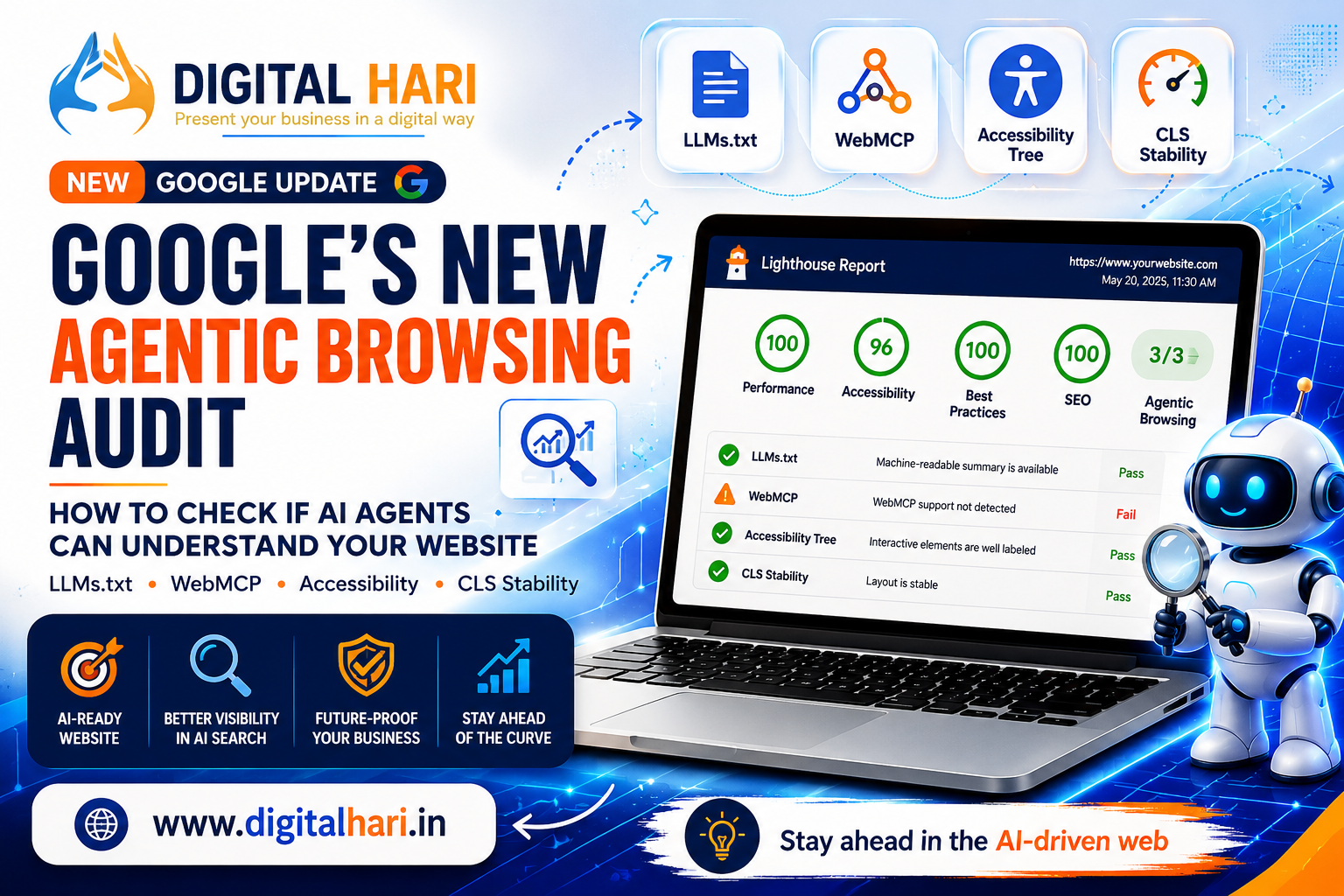
    A new experimental "Agentic Browsing" category has quietly appeared in Lighthouse, allowing developers and website owners to evaluate how AI agents understand, navigate, and interact with their websites. The feature is part of Google's evolving work around the agentic web and AI-ready experiences.

    In this article, I explore:
    โœ… What Agentic Browsing is
    โœ… How to enable it in Chrome
    โœ… How to run the Lighthouse audit
    โœ… Why LLMs.txt, WebMCP, Accessibility Tree, and CLS matter
    โœ… What this means for SEO, AI Search, GEO, and AEO

    My biggest takeaway?

    The future of website optimization isn't just about helping search engines crawl your pages—it's about helping AI systems understand, navigate, and even interact with your website.

    Whether you're a business owner, developer, or SEO professional, this is a trend worth watching closely.

    ๐Ÿ“– Read the full article:
    https://digitalhari.in/google-agentic-browsing-audit-ai-seo/

    Have you tried the new Agentic Browsing audit yet? I'd love to hear your thoughts and experiences.

    #SEO #AISearch #TechnicalSEO #AgenticBrowsing #AIAgents #DigitalHari #HariharanGandhi #GoogleLighthouse #LLMsTxt #WebMCP #GEO #AEO #DigitalMarketing
    ๐Ÿš€ Google just gave us a glimpse into the future of AI-powered websites. A new experimental "Agentic Browsing" category has quietly appeared in Lighthouse, allowing developers and website owners to evaluate how AI agents understand, navigate, and interact with their websites. The feature is part of Google's evolving work around the agentic web and AI-ready experiences. In this article, I explore: โœ… What Agentic Browsing is โœ… How to enable it in Chrome โœ… How to run the Lighthouse audit โœ… Why LLMs.txt, WebMCP, Accessibility Tree, and CLS matter โœ… What this means for SEO, AI Search, GEO, and AEO My biggest takeaway? The future of website optimization isn't just about helping search engines crawl your pages—it's about helping AI systems understand, navigate, and even interact with your website. Whether you're a business owner, developer, or SEO professional, this is a trend worth watching closely. ๐Ÿ“– Read the full article: https://digitalhari.in/google-agentic-browsing-audit-ai-seo/ Have you tried the new Agentic Browsing audit yet? I'd love to hear your thoughts and experiences. #SEO #AISearch #TechnicalSEO #AgenticBrowsing #AIAgents #DigitalHari #HariharanGandhi #GoogleLighthouse #LLMsTxt #WebMCP #GEO #AEO #DigitalMarketing
    0 Comments 0 Shares
No data to show
No data to show
No data to show
No data to show
No data to show